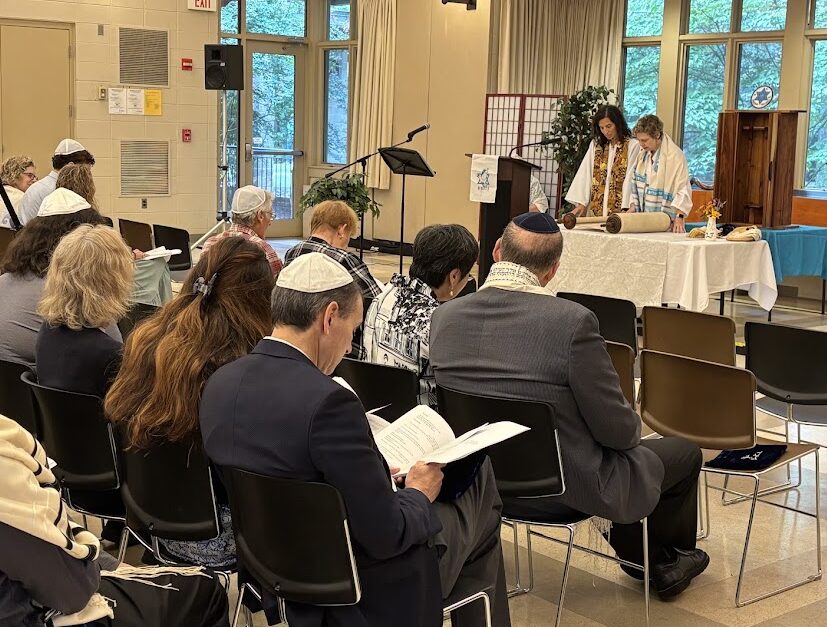
As the High Holy Days come to a close, we invite you to revisit the reflections and insights Rabbi Debbie Reichmann shared during our High Holy Day services. This year’s sermons invite us to reflect on some deeply human questions: How do we move forward after difficult experiences? What brings us together across differences? How can traditions create connection rather than division? And how can we make room for forgiveness, compassion, joy, and the fullness of life?
Whether you joined us in person, participated online, or are discovering these teachings for the first time, we hope these reflections offer something to carry with you into the year ahead.
Erev Rosh Hashanah: The Sacred “Now”
Twenty-five years after 9/11, Rabbi Debbie reflects on how collective trauma reshaped our world and how our search for safety and certainty has sometimes deepened the divisions between us. Rosh Hashanah reminds us that while we cannot rewrite the past, we do have agency in the present—the sacred “now”—to choose connection, grace, kindness, and a renewed commitment to our shared humanity. By finding the points of common ground that connect us to one another, we can begin to rebuild trust and move forward, one small act at a time.
Watch the sermon on YouTube
Read the full sermon
Rosh Hashanah Morning: The Rituals That Bring Us Together
Rituals, both ancient and modern, give shape and meaning to our lives, connect generations, and create shared moments of joy, grief, celebration, and belonging. Rabbi Debbie explores the power of ritual through the experiences of interfaith families, celebrating meaningful steps toward greater inclusion while challenging the idea that a any life-cycle event is merely a “small aspect” of creating a family. Rituals are opportunities to keep showing up for one another—and they should be invitations that bring people closer together, not barriers that keep people out.
Watch the sermon on YouTube
Read the full sermon
Kol Nidre: Two Coats of Many Colors
Through the stories of Joseph’s coat and Dolly Parton’s “Coat of Many Colors,” Rabbi Debbie examines how love, family, pride, and circumstance can shape the wounds and strengths we carry with us. Joseph’s coat becomes a symbol of favoritism, jealousy, and pain created when one person is placed above others, while Dolly’s coat represents resilience, humility, hope, and love. On Yom Kippur, we are invited to examine the “coats” we wear, acknowledge the scars we carry and the wounds we have caused, and can choose to carry forward the qualities that help us live with greater humility, compassion, and resilience.
Watch the sermon on YouTube
Read the full sermon
Yom Kippur Morning: L’Chaim – A Toast to Life
Yom Kippur is often thought of as a solemn day of fasting and confession, but Rabbi Debbie explores it as a sanctuary in time—a place where we can make room for forgiveness, gratitude, joy, and renewal. Drawing on Fiddler on the Roof, she reflects on the contradictions of life and the challenge of holding joy and sorrow, love and disappointment, tradition and change together with compassion. Yom Kippur invites us to examine the lines we draw, loosen our grip on grudges and judgments, and learn to bend without breaking as we embrace the gift of being fully alive.
Watch the sermon on YouTube
Read the full sermon
We hope these sermons continue to offer moments for reflection, conversation, and connection throughout the year. The High Holy Days remind us that we are not bound by our past—that there is always an opportunity to turn, to forgive, to reconnect, to change course, and to begin again. May the year ahead bring moments of joy and gratitude, the courage to embrace life’s contradictions, and the compassion to meet ourselves and one another with grace.
At the Interfaith Families Project, we come together across religious traditions and family backgrounds to celebrate, learn, and create community. Our High Holy Day services are one expression of that larger commitment: creating spaces where people can engage meaningfully with Jewish tradition, bring their whole selves and their families, and find connection with others. We invite you to continue celebrating and learning with us throughout the year.
See our upcoming holidays and events